Redwood National Park, part one.
Everyone has already heard at least once about the giant Sequoias, these gigantic trees that sneeze as far as the sky. We have some in France and Europe that take on great proportions, but not to the point of reaching the size and age of their forefathers.
Redwoods National Park is approximately 5h30 drive from Portland, north of California. Early in the morning, we took the road to the south where we hoped to find freshness. For four days we had been supporting a heat wave with days at more than 102°F (39°C). We took the I-5 towards Salem and then Corvallis, where we had to stop to pick up some camping equipment from friends. The road to Salem made us cross great agricultural plains that we had lost the habit of seeing, mainly seeded with cereals. The region is a large producer of wheat and seed of prairie seeds.
We are used to seeing the harvests around us. However, by circulating and seeing the harvesters at work, something was wrong with our usual references: the machines harvest the wheat while it is already lying down. Apparently the wheat is moaned before it drys and the machine passes. For the curious there is a small film of the harvest. https://en.vecteezy.com/video/2571907-tracking-shot-of-combine-in-field-at-sunset-willamette-valley-oregon-usa
The journey then led us through Route I-84. The road crosses and winds through a landscape of large hills and forests. From Grants Pass we travelled towards Crescent City, where we crossed a very wild landscape. This also allowed us to see the damage of the last fires. A few hectares of burnt forests accompanied us for several kilometres.
Suddenly, just after moving from Oregon to California, a narrow roadway forced us to stop in front of what looked like a small border post. You could read it. « agricultural control ». We are asked if fresh fruit and vegetables are being transported. We just had bananas and plums, it was good, we could pass. If we had cherries and grapes with us, maybe we should have left them in control. In California they don't laugh about it. Since the state is a major producer of fruits and vegetables, it tries to control what comes in to reduce the risk of plant diseases.
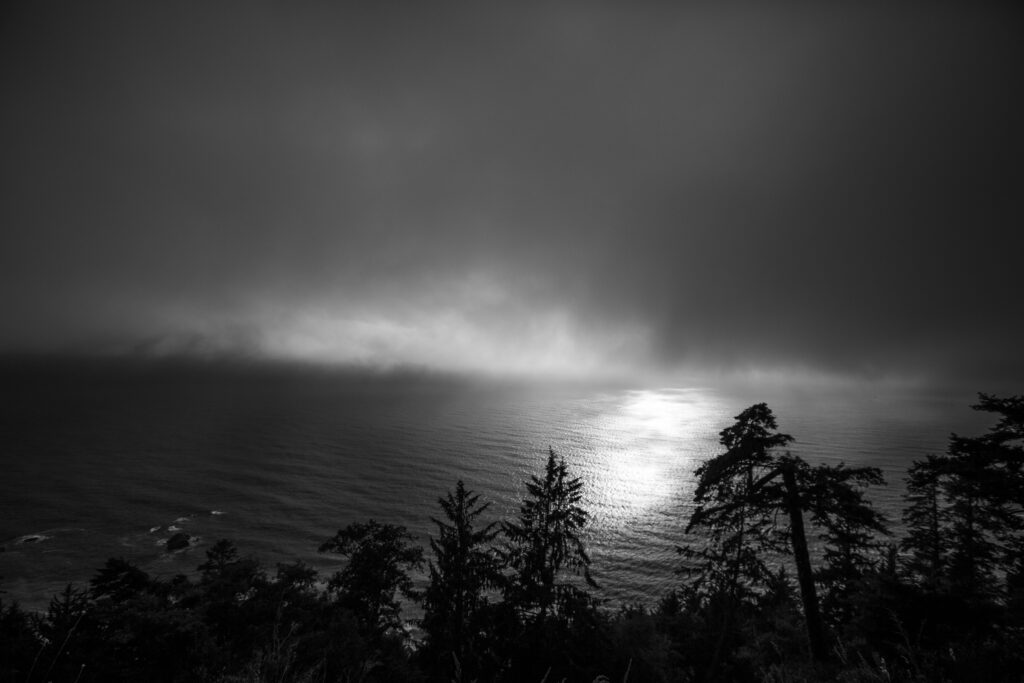
In Crescent City we reached the Pacific, only a few miles to reach our accommodation. We had a rather tight schedule because our host was waiting for us to welcome, but we couldn't resist the ocean call. There were magnificent views on the road, with a declining sun that created beautiful lights. Continuing the road, the first Sequoias made their appearance. Despite the fog that had invaded part of the area that it was crossing, large, dark masses could be seen on either side of the road. Very impressive!
We finally reached our destination at the Gampling Woods, Waves and Wags in Klamath City at Alysson. We rented a garage in which we could sleep. We knew the weather would be more breathable along the ocean, but we were still surprised by the 18-20°C that welcomed us and the freshness of the night.
The next day we headed for the National Park, which was a few kilometres from our place of residence. The first exclaims of wonder arrived quite quickly with the presence of the first Sequoias. We had seen Sequoias of respectable size with the visit of the Hoyt Arboretum to Portland, but without any comparison with what was then discovered. There were many everywhere and no one knew where to give a head. Before we went completely astray, we decided to go to « visitor center » and ask the rangers for advice.
The Ranger who welcomed us first advised us to go and admire the « big trees » near the center. This after a small detour through a small town to eat at Mojo Pizza. We met an American pizzaiolo, formed in Italy and who loves France. Repus, we went back to the park to see these famous giants.
Advertising was not false, the trees are actually giant. We thought we saw the biggest tree in the park, but no, following a sign we could go see another even bigger tree. Really very impressive. It's very difficult to transcribe proportions with words so much it goes beyond our usual references. To give an image, to make a tour of the largest specimens you have to be a dozen people. The height is also very impressive when you see the numbers, although it is also difficult to understand when you are at the foot of the trees. You can feel that they are very high, but you can't decide on a height. You have to be on a point of view that gives a comparison with other trees to see that the Sequoias are really very high. Our road trips offered us these views in places.
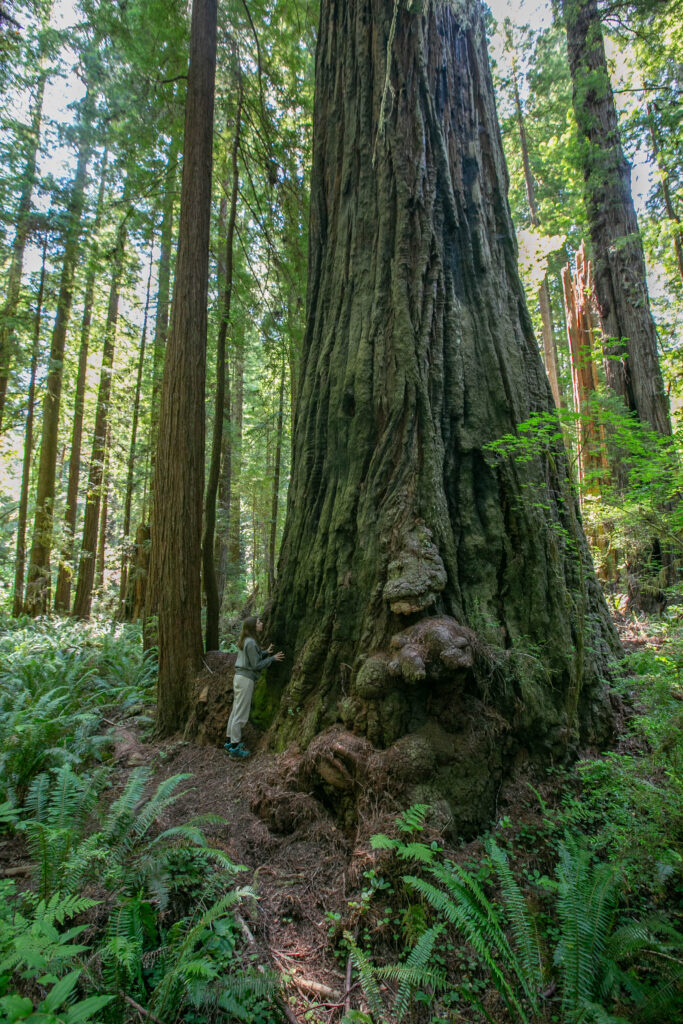
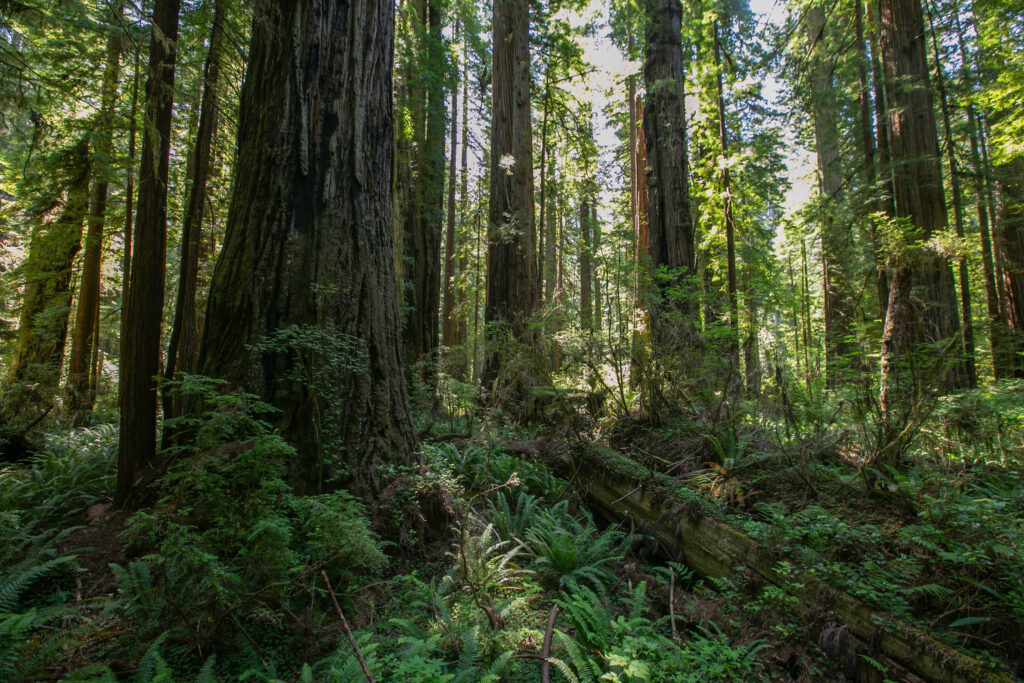
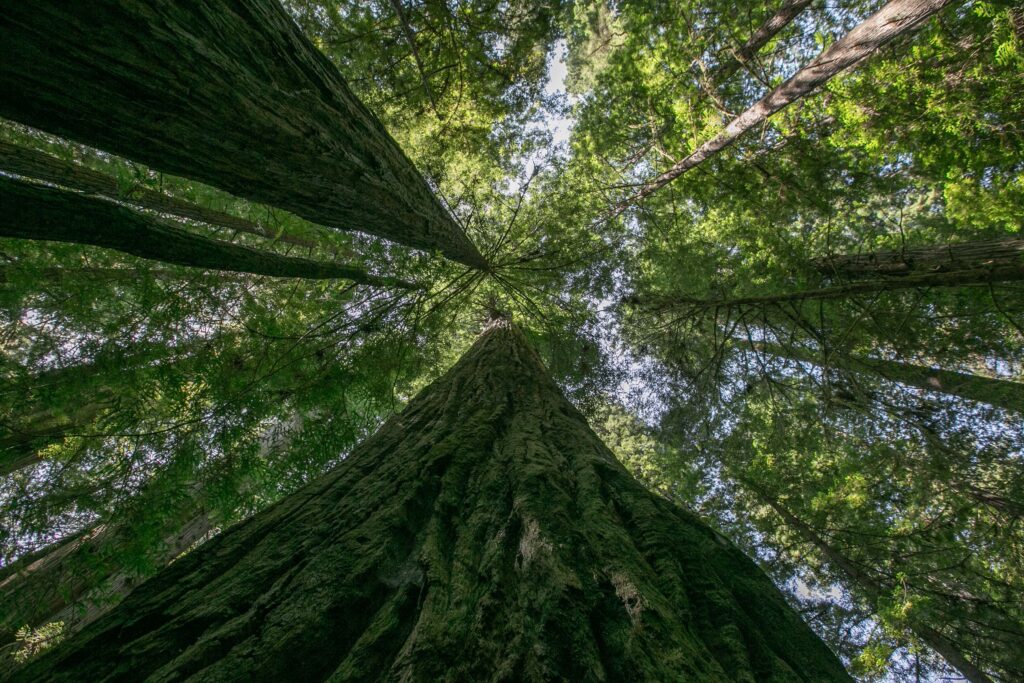
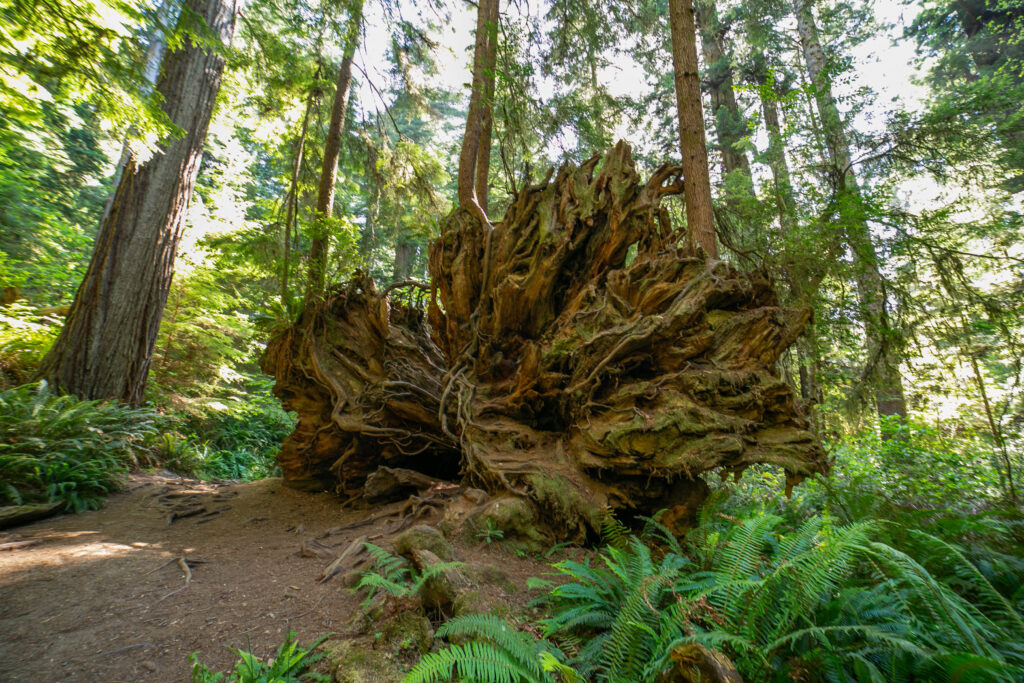
The world's tallest tree was recently discovered by researcher Chris Atkins and naturalist Michael Taylor in 2006. It is called Hyperion and is 116 m high. It is located in a remote corner of the park and kept secret to avoid the influx of tourists and the degradation of the ecosystem.
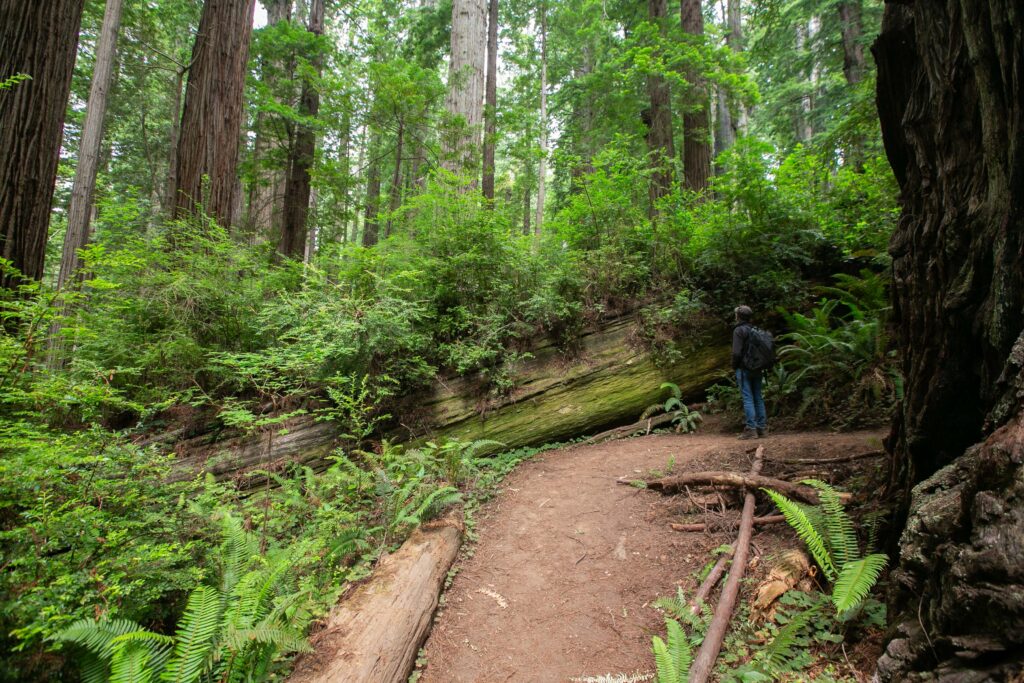
When we talk about Redwood National Park, we obviously imagine the trees and we mainly show the giant trunks of the Sequoia drowned in fog. Yet what makes this place magical is not only the presence of these trees. Indeed, everything that grows below, everything that composes the undergrowth helps to make the paths taken unforgettable. A great calm emanates from these forests, it feels good.
The climatic peculiarity of this part of California and the northwestern American coast is generated by the temperature contrast of the Pacific Ocean and the continent. When we talk about California, we often have the image of the southern state with Los Angeles, San Francisco, waves, surfers, swimming. In the north, we can immediately forget that. The oceanic air masses come to strike against the relief of the coast and condense with the softer air contact. The result is masses of mist that cover the entire forest. It is partly because of this that the Sequoias are so large in this part of the globe. Trees have the capacity to capture this water and use it for growth.
From Europe there is also a tendency to associate California with devastating forest fires. This is a reality and this trend is not going to change with climate change. Last year some fires came to lick the boundaries of the national park, and according to reports, threatened the giants. This is a countertruth, because other morphological and physiological peculiarities allow the sequoias to survive the fires, but above all they are partly dependent on them to reproduce (but neither should fires be too frequent). The old subjects have a very thick and spongy bark that isolates them from the flames. Then, under heat, the cones carried by the trees open and release their seeds. Other species that make up the forest and are not as well equipped for protection, burn and leave room for sequoia seeds that need light to germinate. Walking among the trees it is very easy to observe these traces of ancient fires.
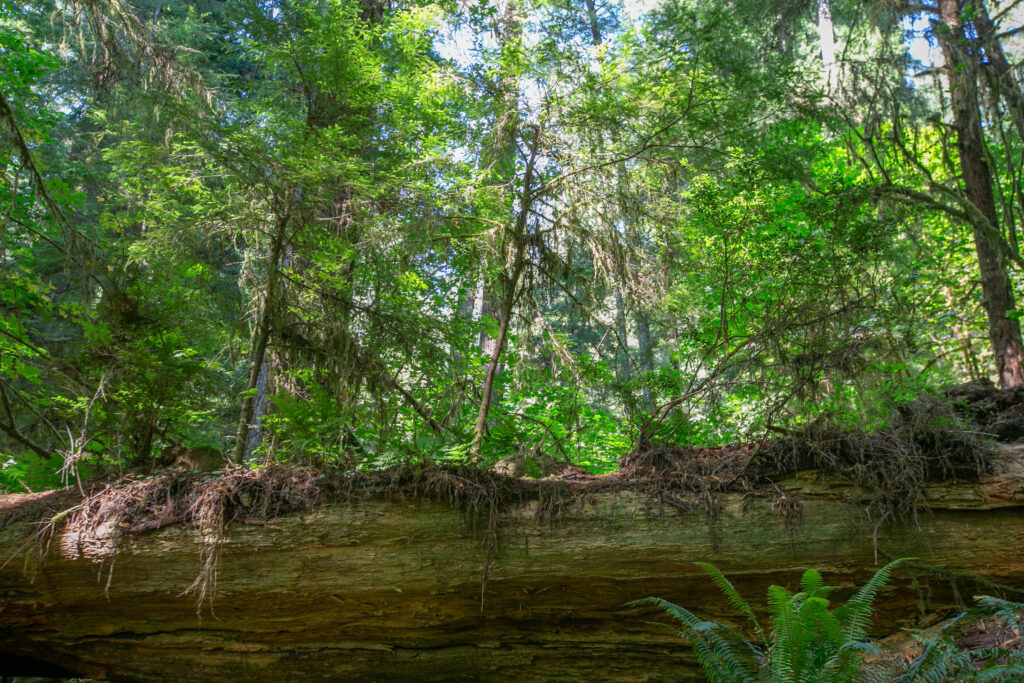
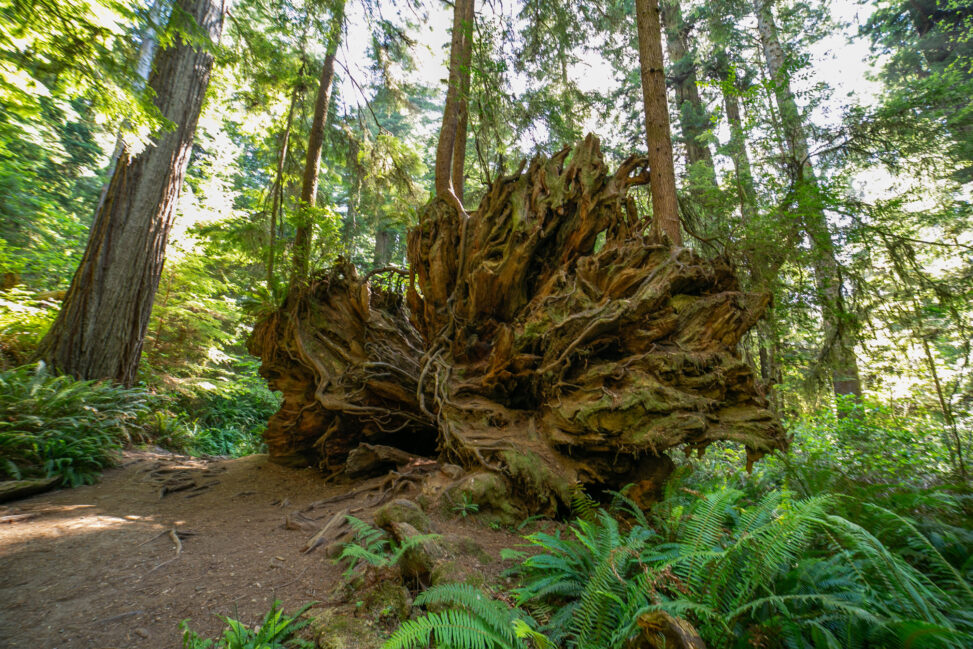
In our various exchanges to describe these places, we have often been short of words. What has come back regularly is the fact that life and death are one, without opposition. What is very pleasant, and it is true for all the forests we have visited so far, is the massive presence of dead wood. The falling trees are left on the ground. The interventions are just to clear the areas that encroach on the trails. Wood degradation is ensured by fungi and offers many plants a growth substrate. Giant trunks of sequoia were found lying and completely colonized by the Airelles (Vacinium ovatum), Fougeres (Polystichum muntum) and Heuchères (Heuchera micranta).